

Where Folklore Meets Food: A Filipino Restaurant's Stunning Cultural Tapestry
How one Australian-Filipino eatery transforms dining into a journey through Philippine mythology and culinary heritage
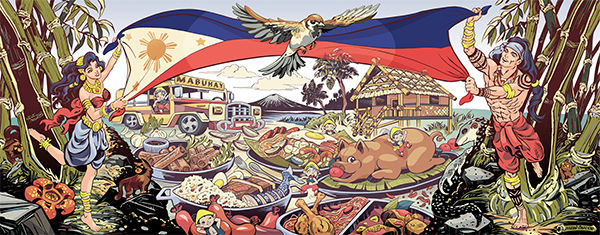
Walking into this Filipino restaurant feels like stepping into a living storybook. Across an entire wall stretches an extraordinary Pinoy Komiks-inspired mural that weaves together the Philippines’ most cherished creation myth with the abundant bounty of its culinary traditions. This isn’t just wall decoration—it’s a masterful celebration of Filipino identity that transforms every meal into a cultural experience.
When Bamboo Split Open the World
At the heart of the mural lies the beloved tale of Malakas at Maganda, the Philippines’ Adam and Eve story that has been passed down through generations. Philippine lore states that Malakas or “The Strong One” and Maganda or “The Beautiful One” surfaced from both sections of the bamboo split open by a great bird. The artist has captured this pivotal moment with remarkable detail, showing the mythical couple emerging from bamboo stalks while a majestic bird soars overhead, its wings spread wide across the composition.
Their emergence marked the beginning of human life on Earth, making them the ancestors of all Filipino people—a powerful reminder to diners that they’re not just eating a meal, but participating in a cultural continuum that stretches back to the very origins of Filipino identity.
The mural’s interpretation of this ancient tale reflects what food historian Felice Prudente Sta. Maria describes as the way Filipino culture is “meant to be shared, way of spreading joy, comfort.” Just as Malakas and Maganda became the progenitors of Filipino civilization, the dishes served beneath this mural continue the tradition of bringing people together around shared stories and flavors.
A Feast for the Eyes and Soul
Surrounding the central folklore narrative, the mural explodes with imagery of Filipino culinary abundance. Tropical fruits spill across the composition—mangoes, bananas, coconuts—while traditional dishes appear to emerge organically from the mythological landscape. The artist has cleverly integrated jeepneys, those iconic Filipino public transport vehicles, creating a visual bridge between ancient folklore and contemporary Filipino life.
This approach would deeply resonate with Sta. Maria, an internationally awarded non-fiction author, cultural heritage advocate, and pioneer in Philippine food history specialising in the Spanish and American colonial eras. Her decades of research have consistently emphasized how Filipino food culture represents layers of history, migration, and adaptation—themes beautifully reflected in this mural’s juxtaposition of mythological origins with modern Filipino life.
The abundance depicted here echoes Sta. Maria’s observation that food isn’t just about the meal but also about the feelings invoked by what is served. Every visual element seems designed to evoke kapamilya—that sense of family and belonging that is central to Filipino dining culture.
Bridging Oceans Through Art
For Filipino-Australians, this mural serves as a powerful cultural anchor. In a country thousands of miles from the Philippines, it recreates the visual and emotional landscape of home. The inclusion of traditional elements alongside recognizable Filipino street food and tropical abundance creates what cultural historians might call a “diasporic masterpiece”—art that maintains cultural authenticity while speaking to the immigrant experience.
Sta. Maria has been gathering written and oral histories of Filipino cuisine since the 1970s, and her approach to preserving cultural memory through food stories finds perfect visual expression in this mural. The artwork functions as both historical document and contemporary celebration, much like her acclaimed works including “The Governor-General’s Kitchen: Philippine Culinary Vignettes and Period Recipes, 1521–1935.”
More Than Decoration
What makes this mural extraordinary is how it transforms the act of dining into cultural education. Children eating here absorb Filipino mythology alongside their adobo and pancit. Adults reconnect with stories their grandparents told them. Non-Filipino diners gain insight into the rich cultural tapestry that informs every dish on the menu.
The detailed linework and dynamic composition create movement throughout the piece—birds in flight, flowing palm fronds, bustling market scenes—that mirrors the energy of Filipino communal dining. Like the best Filipino hospitality, the mural embraces viewers with warmth and story, making every patron feel like part of the extended family gathering around the table.
A Living Heritage
In an era when many immigrant communities struggle to maintain cultural connections across generations, this mural represents something precious: a visual heritage that makes Filipino culture accessible, beautiful, and alive. It honours the scholarly work of historians like Sta. Maria while making that cultural knowledge tangible for everyday diners.
As Sta. Maria noted, she began cooking when she was seven and would save money to buy cookbooks, starting to ask why Filipino food deserved deeper exploration. This mural answers that question with every sweeping line and carefully rendered detail—Filipino culture, from its creation myths to its contemporary expressions, deserves celebration, preservation, and the kind of artistic tribute that makes viewers stop and truly see.
In this Australian dining room, surrounded by the visual echoes of Malakas and Maganda’s emergence from bamboo, every meal becomes a homecoming, every shared dish a continuation of stories that began at the dawn of Filipino time. That’s the true magic of this remarkable mural—it doesn’t just decorate the space, it sanctifies it, transforming an ordinary restaurant into a cultural temple where food and folklore dance together in perfect harmony.
Comments